Sojiwa
A free mood tracker for the weeks of caring for a parent
Mei tracks a heavy caregiving week in Sojiwa: prompts on tired nights, back-dated entries, and a Saturday AI reflection that shows the shape of it.
Written by the Sojiwa editorial team with AI assistance. Not medical advice.

Short answer: Sojiwa is a free journaling app with a mood picker, a daily check-in, guided breathing and an AI weekly reflection. Writing on three different days unlocks the reflection, which reads the week back as a short label, a day-by-day mood trend and notes quoting your own words. It organises how a week looked; it does not lighten it.
On this page
Mei is 41 and lives twenty minutes from her mother's flat in PJ. On Monday she was at the clinic by 8.40am for a follow-up appointment, holding two folders and a bag of porridge that went cold in the waiting room. By nine that night she was on the sofa with the TV on mute, thumb hovering over her phone, too flattened to write anything from scratch. That is how most weeks of caring for an aging parent end up: not dramatic, just full.
She opened Sojiwa, tapped Create journal, and titled the entry about the rushed morning before the clinic. Then she picked a mood from the ten, Tired, and looked at the single line sitting at the bottom of the writing box. It was a reflection prompt. Tapping it dropped the question into the text, so she answered that instead of inventing a first sentence. Some nights that is the whole difference between an entry existing and not.
She has been using it as a free mood tracker for a while now, mostly because the entry takes ninety seconds and the mood is required anyway. There is no subscription.
Tuesday goes missing, and Wednesday fixes it
Tuesday was a blur of pharmacy queue, a phone call to the insurance line, and reheating soup. No entry. She did not open the app at all.
On Wednesday night she tapped the date at the top of the screen and back-dated Tuesday's entry. The mood she chose was Anxious, and she attached one photo, the discharge slip from the clinic folded on the kitchen counter. Back-dating matters more than it sounds. Without it the week reads as patchy, a series of blanks, and the blanks start to feel like evidence of something. With it, Tuesday is simply there, recorded, in its own place.
She left the title blank at first and the app would not save it. Title, text and one mood, all three. It is a small friction that turns out to be useful, because a title forces her to name what the day actually was.
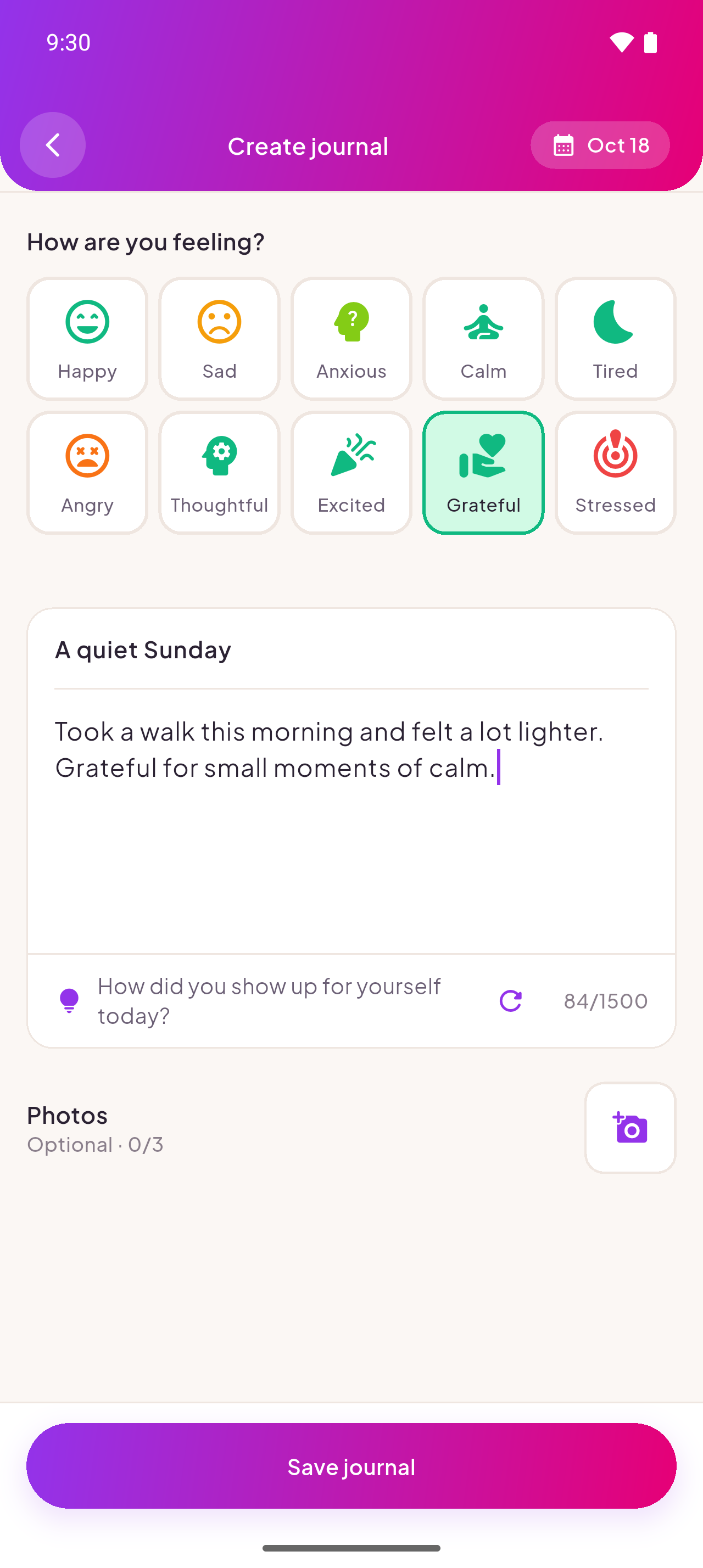
Thursday, a question that fits
Thursday had a good half hour in it. Her mother laughed at something on the radio, properly laughed, and they ate kueh at the small table by the window.
That night Mei wrote a short entry, mood Grateful. The prompt line offered a question about what had been hard that day, which was not what she wanted to answer, so she tapped Another prompt once. The next one asked about something small that went right. She wrote four lines about the radio and the kueh and stopped. The prompt is not fixed for the day. It swaps, which means the app is not insisting the week be one kind of week.
Friday she did not journal at all. She opened the Pet tab instead and patted the little kancil she adopted months ago, watched it blink, and closed the app. A minute of that, then bed.
Saturday, the report
By Saturday she had written on three different days, which is the point at which the AI reflection becomes available. She tapped Analyse journals on the Home screen.
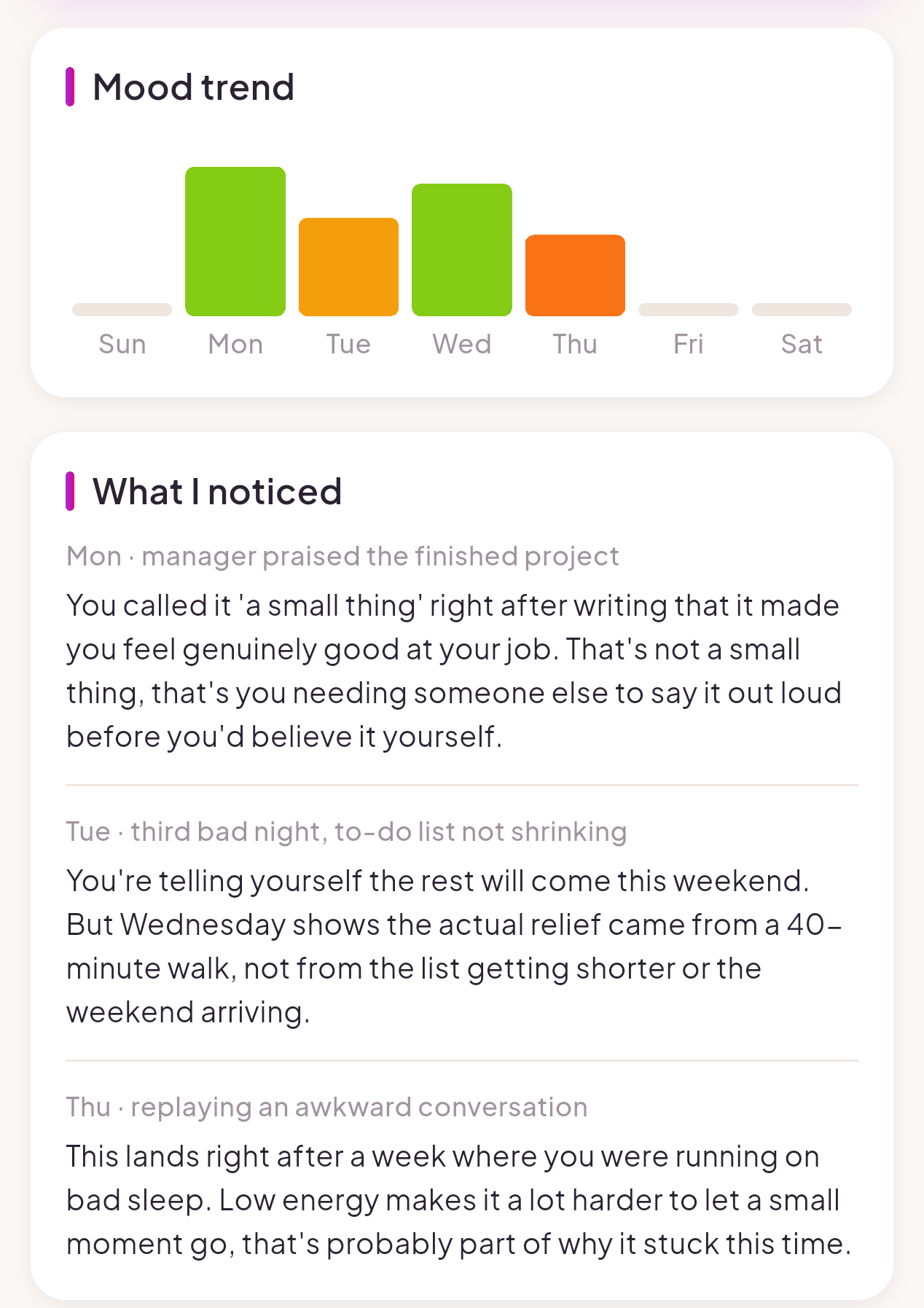
The report arrived on the AI analysis & motivation screen. At the top was a short label for the week, then a headline paragraph, then a Mood trend bar with one column for each day that had an entry. Monday and Tuesday sat lower than the rest. Days she had not written stayed empty rather than being guessed at.
Under What I noticed was a line that started with a weekday and quoted a few of her own words back at her, the ones about the clinic visit and the cold porridge. She had not remembered writing the porridge part. That was the bit that landed. The week had a shape she could look at, and the shape was: Monday and Tuesday were heavy, Thursday was not, and she had survived all of it.
It is worth saying plainly that the reflection costs a few tokens, and that the tokens come from things like the daily check-in. It also did not make the caregiving schedule any lighter. Her mother's appointments are the same appointments. The medication times are the same times. What changed is only this: the week stopped being an undifferentiated grey mass and became three recorded days, two of which were hard and one of which had kueh in it.
Try this today
After a clinic visit, when the evening has that wrung-out feeling and your shoulders are up near your ears, try the Calming breathing exercise in Sojiwa, the one with the long exhale. Breathe in for a comfortable count and let the out-breath run longer than the in-breath, following the circle on screen.
A longer exhale is the part that does the work, because it slows the pace you are breathing at and gives the tense part of the evening somewhere to go. It takes a few minutes and you do not have to think about anything while it runs.

Write it down in Sojiwa
A free journal with prompts to help when you're not sure what to write.
Next week, the same small habit
When the following week starts, open Create journal, pick a mood, and write whatever the day was. Three days of that is enough for the reflection to have something to read back to you.