Sojiwa
How to Track Your Mood Every Day
Track your mood well: log it the same day, pick a precise word, and add one line of context so real patterns show up in your week.
Written by the Sojiwa editorial team with AI assistance. Not medical advice.

Short answer: Track your mood by logging it the same day you feel it, at a fixed time, with the most precise word you can find rather than "good" or "bad." Add one line about what happened just before, because the pattern in your week shows up in that context more than in the mood itself.
On this page
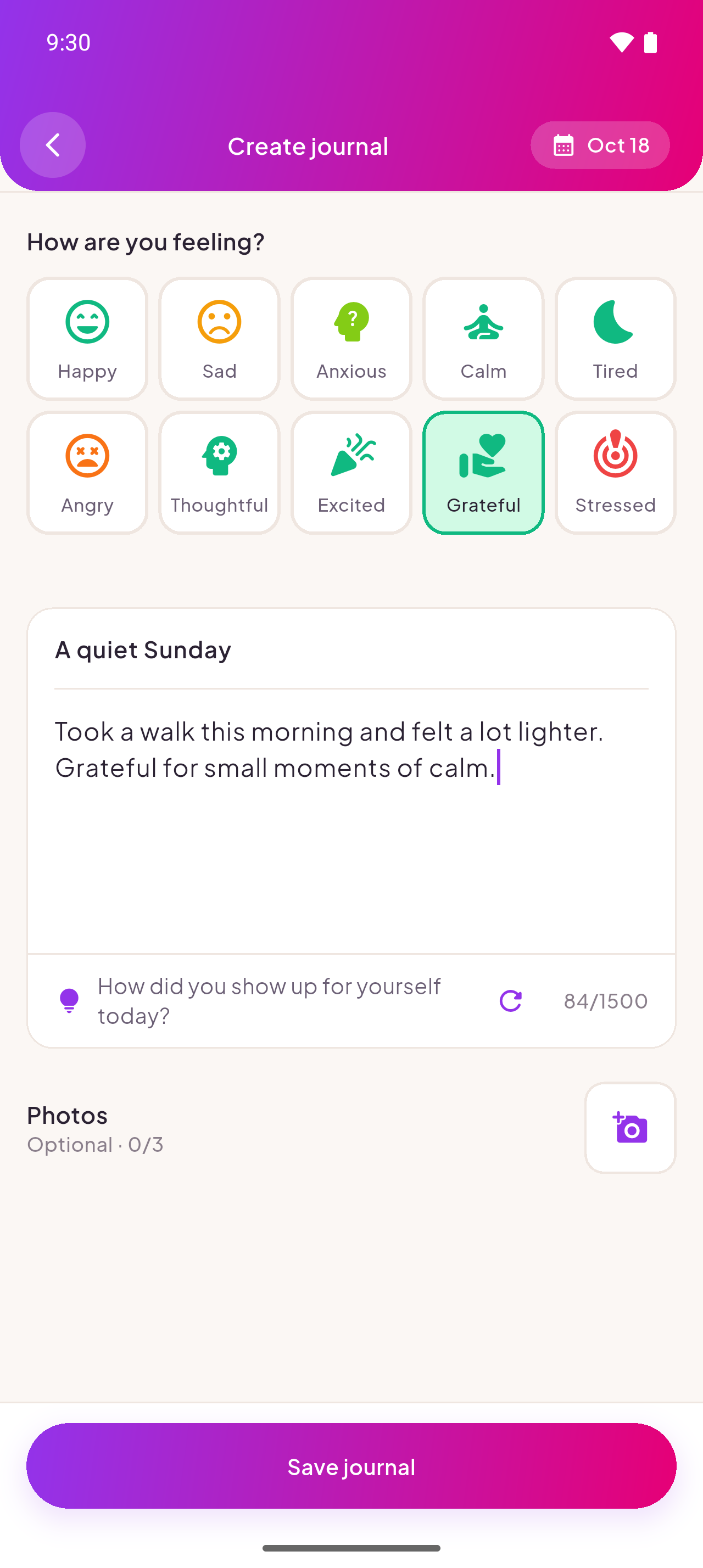
Say Mei is 34 and works in payroll in Petaling Jaya. It is Thursday night, the laptop is finally shut, and she has Sojiwa open on "Create journal." Her thumb hovers over Sad, then moves to Tired.
Under the title "Thursday," she types one line: "Fell asleep on the sofa at nine. Not sad, just empty."
Your memory of the week is not your week
On Sunday, if you ask yourself how the week went, your answer leans heavily on the most intense moment and on how it ended. Psychologists call this the peak-end effect.
Four calm days and one awful Friday meeting get remembered as a bad week. A log written on Sunday records the memory, not the days.
That is why each entry has to be written the same day, close to the feeling. Sojiwa lets Mei back-date an entry by tapping the date at the top of the screen. That works for catching up on what happened, but a mood picked a day later is already a memory.
Pick one fixed moment to log, such as after dinner. Mood drifts across a day, and a rating from a rushed 7 a.m. and one from a quiet 11 p.m. are measuring two different things.
Choose the word that tells you what to do next
"Bad" has no next step. A precise word does. Tired points toward rest. Anxious points toward something coming up. Sad points toward something lost, and Angry toward a line someone crossed.
Mei's switch from Sad to Tired changed her Friday. Sad might have meant calling her sister. Tired meant phone down and bed by ten.
Researchers call this skill emotional granularity: telling feelings apart in fine detail. People who do it well tend to handle stress better, partly because a precise label leads to a fitting response instead of a blunt one.
Naming the feeling also does something on its own. Studies on "affect labelling" have found that putting a feeling into words can take a little of the intensity out of it, even when nothing else changes.
The pattern lives in the context, not the mood
A mood with no context only tells you that you felt it. One line about what happened just before, who you were with, or how you slept is what lets a pattern appear.
After a week or two, check your own entries for these:
- A weekday that dips most weeks. It is often the day after a heavy one, not the heavy day itself.
- Low days that follow short nights. If the dips line up with late nights, sleep is a lead worth testing.
- People or places that keep showing up on your better days.
- Where your gaps fall. Skipped days are easy to read as neutral. If they keep landing on the same kind of day, those may be the days that matter most.
On Sunday, Mei taps "Analyse journals" on Home. The reflection costs a few tokens. Her report shows a Mood trend bar for each day she wrote, and Tuesday sits empty because she skipped it.
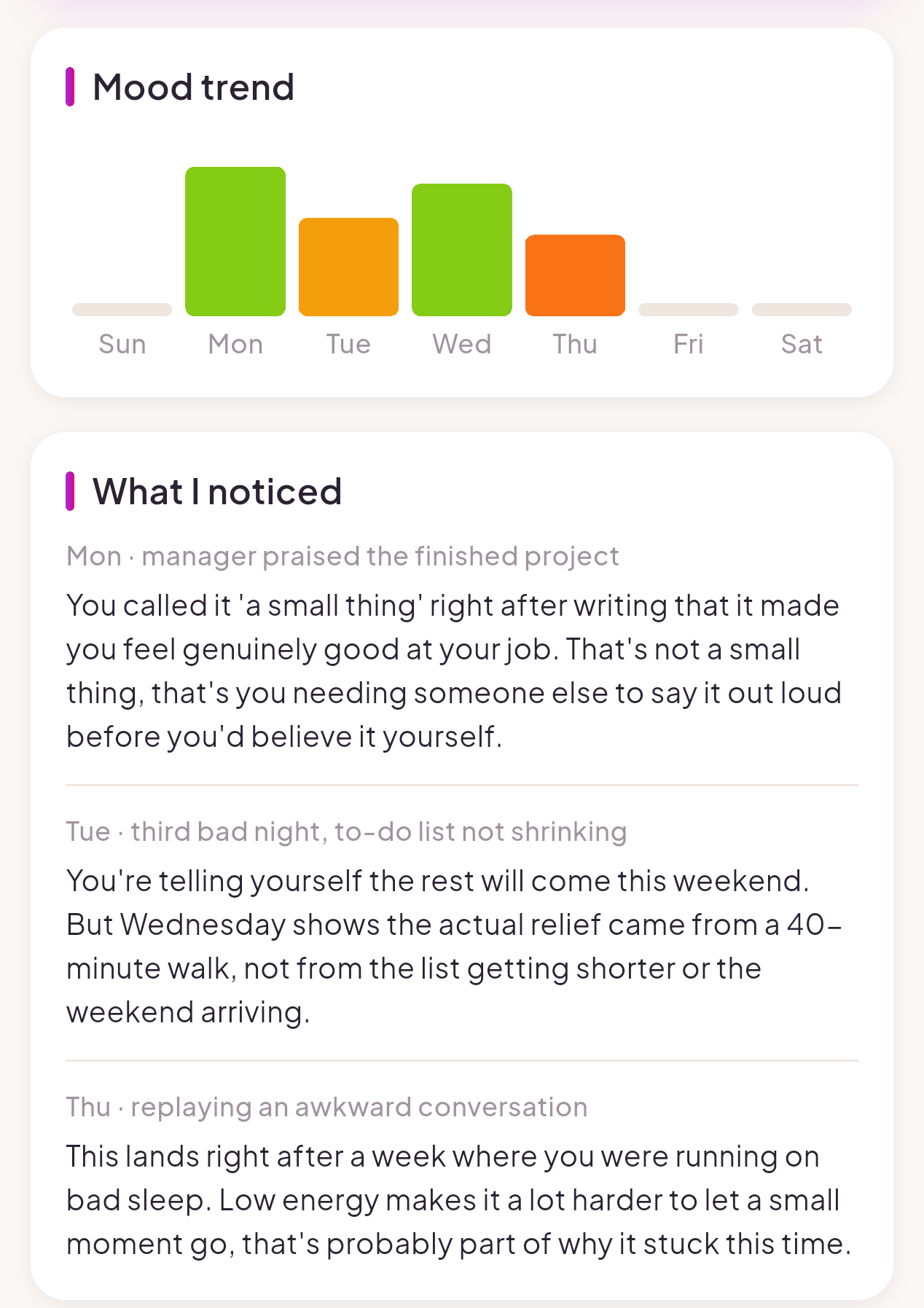
One "What I noticed" item starts with Thursday and her own words, "not sad, just empty." It points out that Monday's entry, marked Stressed, mentioned month-end payroll. That surprised her. Her tired days were not random. They trailed her stressed ones by two or three days.
The report did not tell her what was wrong or what she has. It showed her a sequence she could not see from inside the week.
Some patterns are a reason to see a doctor. That includes low mood on most days for two weeks or more, losing interest in things you used to enjoy, or sleep or appetite that has changed a lot. If you have thoughts of hurting yourself, contact a local helpline or emergency service today.
Try this today
Tonight, after you name your mood, write one answer to this:
What happened in the two hours before I felt this way?
The question ties each mood to a cause you can actually check. A week of these answers gives you something to compare. A week of mood words alone does not.

Check in with one tap
Record how you feel today and see how your mood changes over time.
Start with tonight's entry
Open "Create journal," write a title and one line, and pick the mood that fits best. Once you have entries on a few different days, tap "Analyse journals" on Home. You will see a bar for each day you wrote, and an empty space for each day you did not.