Sojiwa
What Are Some Good Mood Journal Examples?
Real mood journal examples, what to write when you feel nothing, and how a week of entries turns into a pattern you can actually see.
Written by the Sojiwa editorial team with AI assistance. Not medical advice.

Short answer: A mood journal works best when each entry pairs what happened with what you felt and one concrete detail. Naming a mood, even a vague one, is the entry. A week of those entries is enough for patterns to show up.
On this page
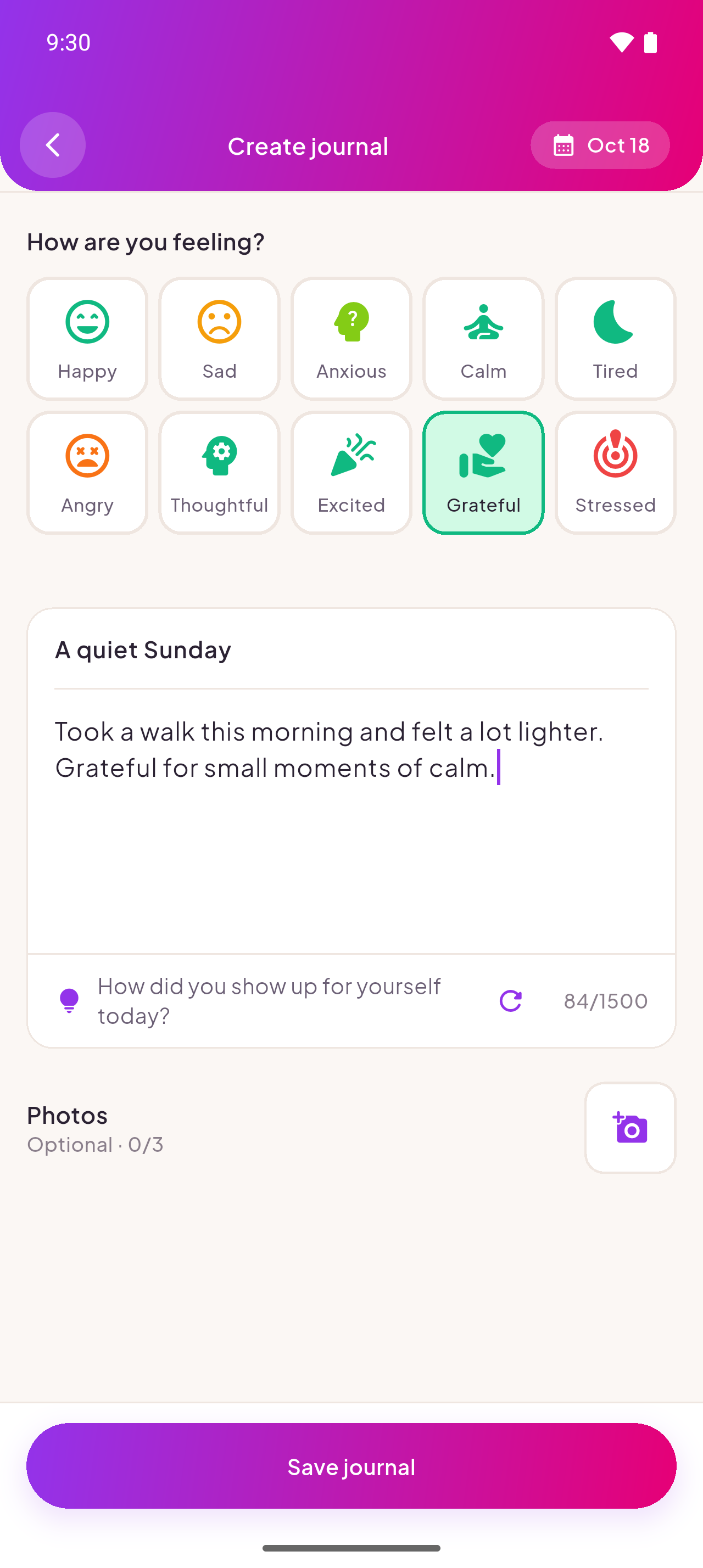
Say Mei is 34, on the train home, thumb on her phone. She opens Sojiwa, taps "Create journal", types a title, and picks a mood from the ten the app offers. Tonight it is Tired. She writes three lines about a meeting that ran long, saves, and puts the phone away. The whole thing takes under two minutes.
That is one mood journal example. Not a good one or a bad one. Just an entry that now exists, with a mood attached and a day attached, which is more than most people have when they try to remember how last month went.
The useful part of an entry is the detail, not the feeling
"Mood: anxious" tells you almost nothing a week later. You will not remember what it was about. A line like "anxious before the 9am call, fine by 10" is a different object: it has a before, an after, and a thing that caused it.
That structure is worth copying. Event, feeling, what happened next. Three short lines is enough. Mei's entry from a bad Tuesday reads: "Presentation moved to Thursday. Stomach dropped. Ate lunch outside and forgot about it by 2." Six months from now she will know exactly what that day was.
The second thing worth knowing is that a mood picker is not decoration. Choosing one of ten words forces a decision the brain otherwise skips, because "fine" is easier than "tired but not sad". People who write freely for weeks often notice they use the same three words about everything. Picking from a fixed list breaks that loop.
What to write when you feel nothing at all
Flat days are the hardest to log, and they are also the ones people most need on record. "Nothing" is data. So is "fine".
Try describing the body instead of the feeling. Shoulders up or down. Jaw tight or loose. Breathing shallow or slow. Most people can report the body on days when they cannot report an emotion, and the body usually knows first.
Or write the smallest true sentence you can defend. "I did not want to answer the phone today." That is an entry. It does not need a reason attached, and you do not need to resolve it.
Some people also write down what they did rather than how they felt: walked instead of taking the bus, skipped lunch, went to bed at a reasonable hour. Later, when the mood pattern shows up, the behaviour is often sitting right next to it.
A week is where examples turn into a pattern
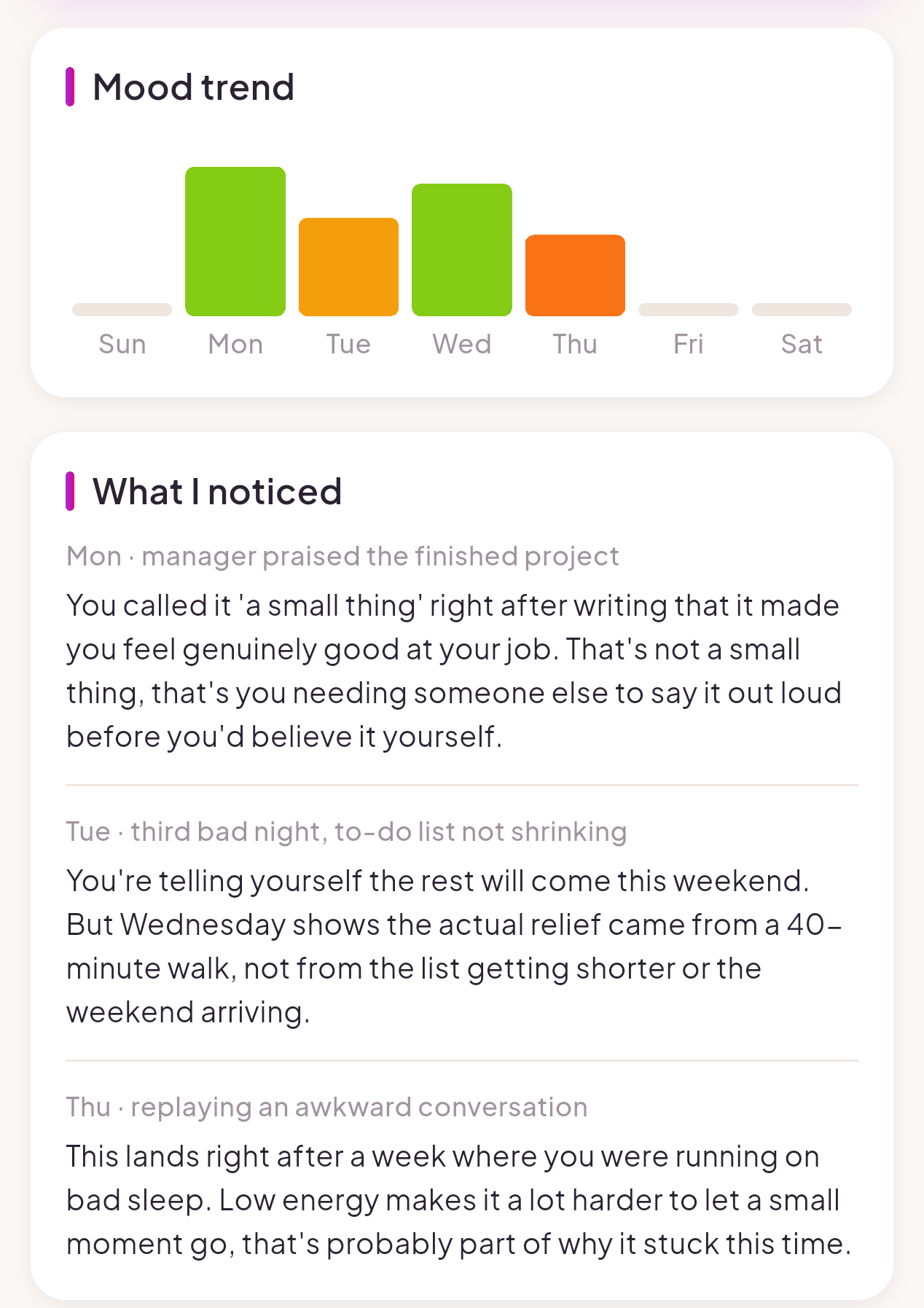
One entry is a snapshot. Around seven days of entries, the AI reflection in Sojiwa ("Analyse journals" on the Home screen) reads the last week or so and returns a report: a label for the week, a headline paragraph, a bar for each day that has an entry, and "What I noticed" items that quote the user's own words back with the day they came from.
That quoting is the part people do not expect. Mei ran hers after nine days and the report flagged that every entry mentioning her sister was written on a Sunday. She had not noticed. Nobody would notice that from inside the week.
The report also has a "Something you may have missed" section and a few suggestions, and it looks back at earlier reports, including whether last week's suggestion actually happened. One limitation worth stating plainly: the analysis costs a few tokens, and it needs entries on a few different days before it will run. You earn a token for each daily check-in, so a week of check-ins covers it without paying anything.
If an analysis cannot be completed, the tokens come back. Past reports stay under "AI advice history".
Try this today
One prompt, written as the first line of tonight's entry:
What did today cost me, and what did it give back?
It works because it asks for a trade rather than a verdict. "Good day" and "bad day" are conclusions you can argue with; a cost and a gain are two facts you can just write down, and they are far easier to find again next week.

Write it down in Sojiwa
A free journal with prompts to help when you're not sure what to write.
Pick a mood before you write anything
Open Sojiwa, tap "Check in" on Home, and choose one of the five faces. That is the whole task, and it earns a token. The five faces are the check-in's own scale, separate from the journal's ten moods, so you are not committing to anything you will have to explain. Then, if you want, tap "Write" and add the prompt above as your first line. If you miss a day, the streak restarts, and the check-in itself cannot be filled in afterwards. The token you already earned stays.