Sojiwa
Journaling · Habits & Self-Care
How to Journal Consistently Every Day
Why journals stall after a missed day, how small minimums and daily cues keep you writing, and how rereading makes the next entry worth it.
Written by the Sojiwa editorial team with AI assistance. Not medical advice.

Short answer: Journaling sticks when the smallest acceptable entry is tiny, when writing is tied to something you already do every day rather than a clock time, and when you skip a missed day instead of catching up on it. Rereading your entries every week or so gives the habit a payoff that keeps it going.
On this page
Say Aisyah is 31 and works as a logistics planner in Penang. It's Thursday night, she's on the sofa, and Sojiwa is open on "Create journal". Her last entry was Sunday.
A draft from Monday is still waiting: three lines about a meeting, abandoned halfway. Four empty days feel like something she owes the page an explanation for, and her thumb hovers.
Most journals stop the day after a missed day
The missed day itself rarely ends a journal. The next one does, because it suddenly feels like it has to cover everything since the last entry. A catch-up entry is bigger and harder, so it gets postponed, and the gap grows.
The fix is to never catch up. Aisyah types "Thursday" as the title and one line: "Ate dinner standing up again." She picks Tired as her mood and saves before her tea has cooled.
Sojiwa's journal keeps no streak counter, so a gap resets nothing. You can back-date an entry by tapping the date at the top of the screen. Use that only for a day you remember something specific about. Otherwise the entry becomes a summary of that day written in today's mood, which is less honest than leaving it blank.
The smallest entry you allow decides whether you keep going
How much you write on a good day says little about whether you'll still be writing next month. The size of the smallest entry you'll accept says much more, because the hard days are the ones that end a habit.
Decide that minimum before you need it. In Sojiwa the real floor is a title, some text and one mood. A single line still logs that mood, and the mood is what you'll use most when you look back.
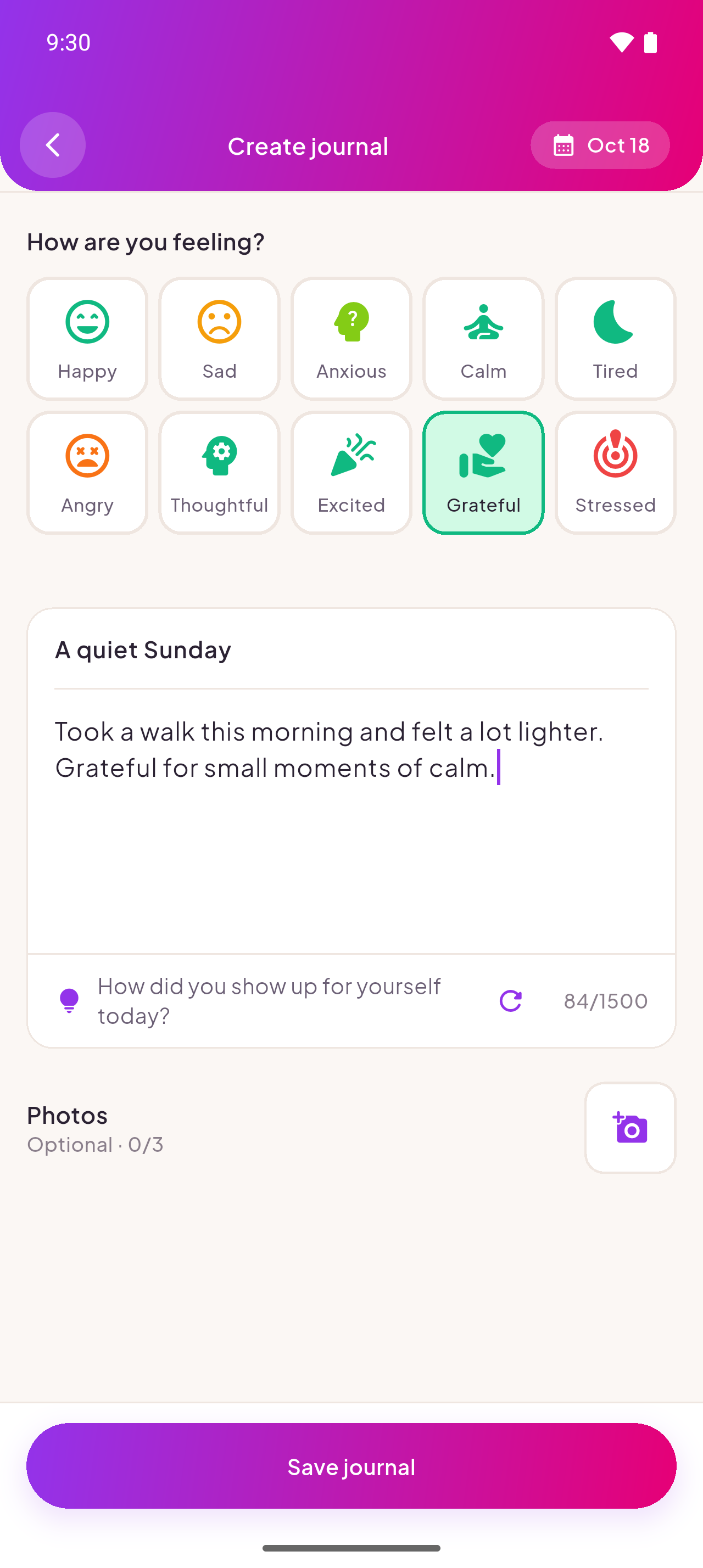
On Friday, Aisyah taps the reflection prompt at the bottom of the writing box. It drops the question into her text, and "Another prompt" swaps it if the first doesn't fit. This one does. She writes two full paragraphs about a colleague who left.
The one-line Thursday made the long Friday possible. She didn't have to decide whether she had energy to write, only whether she had energy for a line.
Tie writing to something you already do, not to a time
"I'll write in the evening" breaks on the first late night, because evenings never look the same twice. A plan phrased as "after X, I write" holds up better. The cue happens whether your day ran late or not, and you never have to stop and decide whether now is the time.
Sojiwa has no reminder setting, so the cue has to come from your own routine. Good cues happen daily, take a few seconds, and leave your hands free for your phone:
- the last stop of your commute home
- waiting for the kettle
- putting your phone on charge for the night
Aisyah picks the charger. The phone goes on the cable, the journal opens, one line minimum. On nights she's too tired for even that, she still opens the screen, and opening it usually turns into a line.
Rereading is what makes the next entry feel worth writing
Writing without ever reading back is effort with no visible return. Habits that never pay back fade, even ones you believe in.
"Journal history" shows a calendar where each day with an entry carries a small mood-coloured dot. On Saturday, Aisyah sees dots on Sunday, Thursday and Friday, and an empty stretch in the middle. Those empty days line up with her late shifts.
The gaps are information. Her journal goes quiet on exactly the days she most needs somewhere to put things. That tells her to use the line minimum midweek rather than to try harder.
Once there are entries on a few different days, "Analyse journals" on Home gives a weekly reflection that quotes a few of your own words next to the day you wrote them. It costs a few tokens. It can point out a pattern, but it can't change her shift schedule.
Rereading can also show something heavier. If the same low mood fills most of your entries for weeks, or writing starts leaving you feeling worse rather than clearer, that's a reason to see a doctor.
Try this today
Write tonight's entry to this prompt, and stop after one sentence if one is all you have:
What's one thing from today I'd want to remember by the weekend?
The question looks forward to a reread, so the entry has a reader from the moment you write it. It's also small enough to answer on your worst day.

Write it down in Sojiwa
A free journal with prompts to help when you're not sure what to write.
Write one line in Sojiwa now
Open "Create journal", give the entry a title, type one sentence and pick a mood. Those three are the whole minimum. When you open "Journal history" afterwards, today's date carries its first mood-coloured dot.