Night shifts blur your week; Sojiwa's AI keeps the thread
28 September 2026 · Priya Nathan
Written by the Sojiwa editorial team with AI assistance. Not medical advice.
Say Priya is 25, works night shifts at a care home in Jurong East, and by Thursday she genuinely cannot remember whether the tiredness started Monday or Tuesday. That is roughly what people mean when they talk about an AI journal app that talks back: not a chatbot that replies to every sentence, but something that reads your week and tells you what it sees. Priya has Sojiwa installed on her Android phone, and for the past few nights she has been writing into it in the small hours between rounds.
Three nights in, the entries are short
The first night back on shift, Priya typed two lines on the way home and picked Tired. Wednesday, after a resident's family visit went badly and she spent an hour calming everyone down, she wrote three lines and chose Stressed. Friday, she managed a single sentence about the bus being late and picked Tired again. None of it felt like journaling. It felt like dropping her bag by the door. She did not go back and read any of it, which is exactly why nothing had surfaced yet.
On her day off she taps the button and gets stopped
Saturday morning, still on night-shift hours, Priya opened Sojiwa and tapped "Analyse journals" on the AI Analysis & Motivation screen. The screen told her it needed entries on at least three different days of that week before it could read anything. She counted: Wednesday and Friday. Two. The week wasn't finished, and she could not be bothered to wait.
So she went back into the journal, tapped the date at the top of the Create journal screen, and back-dated a short entry to Wednesday of the previous week. Four lines about a supply cupboard running out of gloves and the handover being rushed. Mood: Stressed. It took under a minute, and she went back to bed.
The report arrives while she's eating breakfast
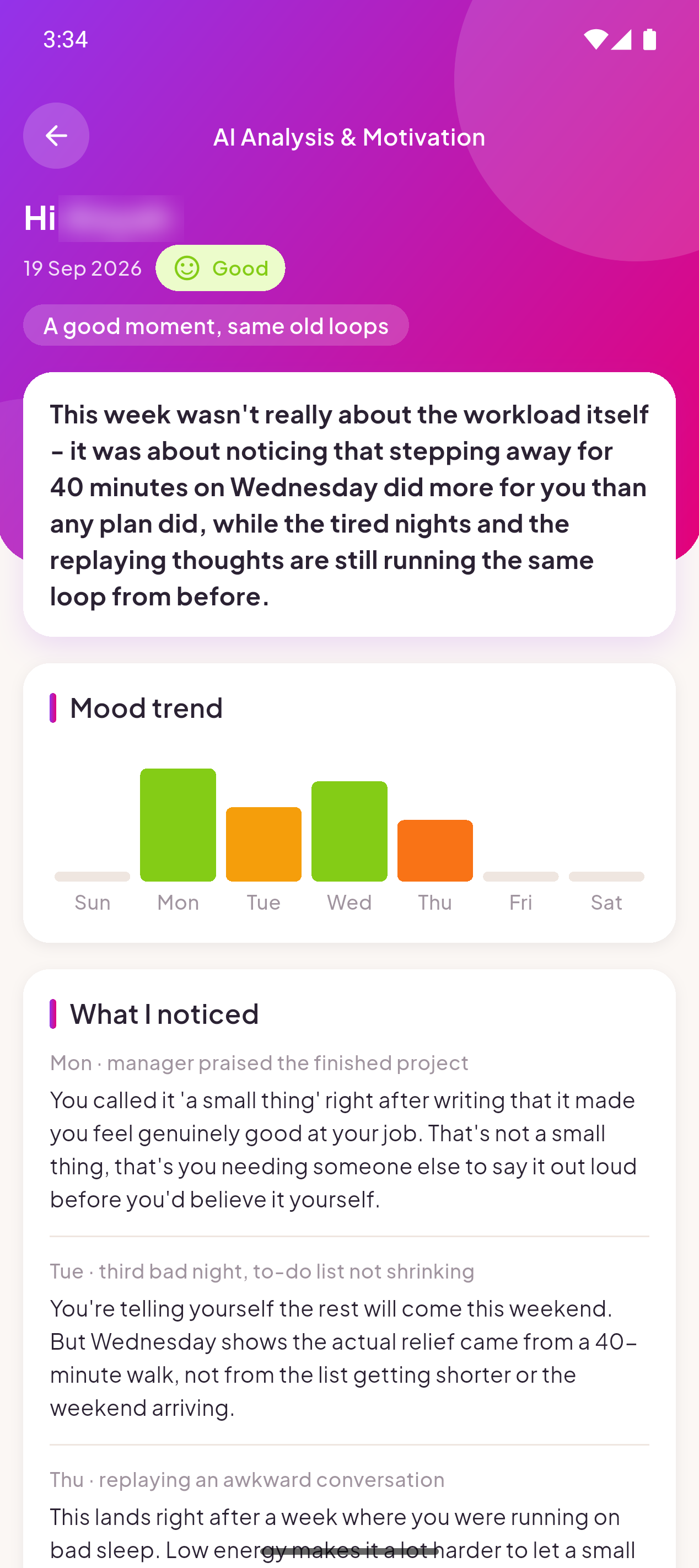
She tapped "Analyse journals" again. It cost a few tokens, and the report landed within minutes. At the top sat a short label for the week, something close to "running on fumes but still showing up". Under it, the headline paragraph, and then the Mood trend bar, one bar for each day she had written and an empty space where she hadn't. Tuesday sat blank in the middle of the row.
That gap did more than the words did. Priya had assumed the hard part of the week was Thursday. The bar showed her the stretch she had no record of at all, and she sat with that for a while.
It quotes her back, and it remembers last week
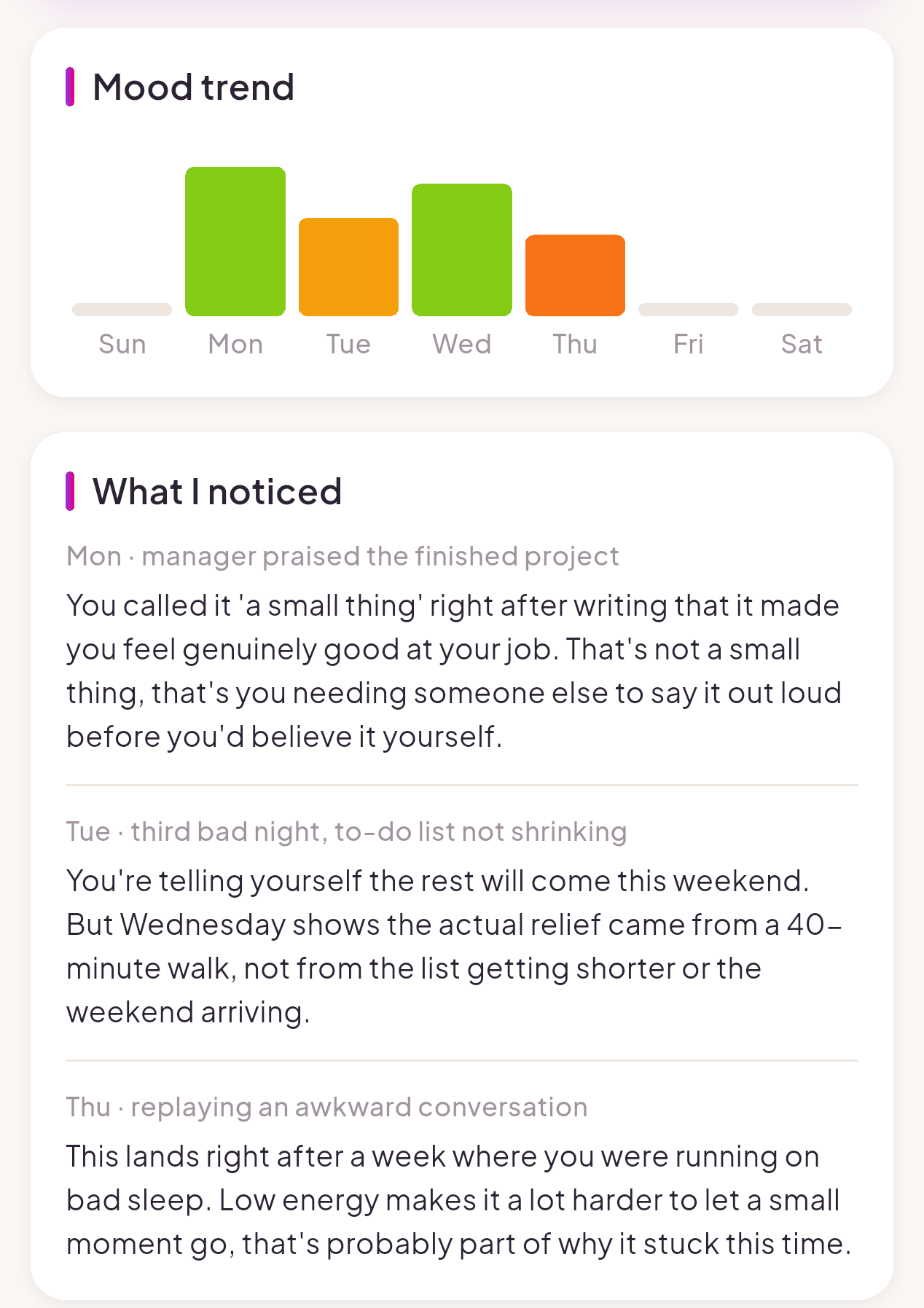
The part that made her put her toast down was "What I noticed". Each item started with the day and then a few of her own words. "Wednesday, 'couldn't settle after the handover'." "Friday, 'bus again, straight to bed'." Lines she had typed half-asleep, now sitting in a list together where she could see the shape of them.
One item reached further back. It referenced her previous week's report and asked, in effect, whether the thing she had said she would try last time had actually happened. She had suggested to herself that she'd take the longer route home past the market. She hadn't. There it was, in the report, not as a telling-off but as a plain question.
What it did not do
It did not tell her when to sleep. It did not rearrange her shifts, and it did not tell her the tiredness meant anything in particular. Priya is the one who has to lie down at 9am with the curtains closed while the rest of the block goes to work. The report only reflected what she had already written down, and left the rest to her. That restraint is the reason she kept using it.
One thing worth knowing before you rely on it: the weekly reflection costs a few tokens, and it needs entries on at least three different days first. On a night-shift week that takes some remembering.
Before any of that, there's the daily button
Separate from all of this, Priya taps the daily check-in on its own screen, one button, "Check in and collect 1 token", usually from the bus stop at 7am. It records no mood and no words. It just keeps her streak going with a tick on this week's row. On Thursday, when she'd missed one, the row showed a cross next to the gap and a star where today sat. She didn't try to make the missed day up. There's no way to, and she has stopped minding.
Try this today
After a night shift, before you get into bed, run the Relaxing 4-7-8 breathing exercise: breathe in for four counts, hold for seven, breathe out for eight. The long exhale is the part that matters. It gives your body a slow, countable thing to do while your head is still replaying the ward, and it takes less willpower than lying there trying to switch off.
Write on a few more days this week
The next chance she gets, Priya opens the journal and adds a short entry, even three lines, so that by this time next week there are entries on enough different days to tap "Analyse journals" again. Her target is four days rather than three, so that one missed evening doesn't push the report out of reach. The mood picker sits right there on the entry, and the reflection prompt card above it gives her a question when she has nothing to say. Then she'll read the new report and see whether the gaps have moved.
That is the whole loop. Nothing dramatic happens in it, and that is rather the point.
Written by
Priya Nathan · Mental Wellness Writer
Priya writes calm, plain-spoken pieces on stress, mood and self-care for the Sojiwa editorial team, more interested in why something helps than in another list of tips.
Keep reading
Ready to start your own journal?
A few honest minutes a day, with gentle AI-assisted reflection along the way — that's all Sojiwa asks of you.
Get the app